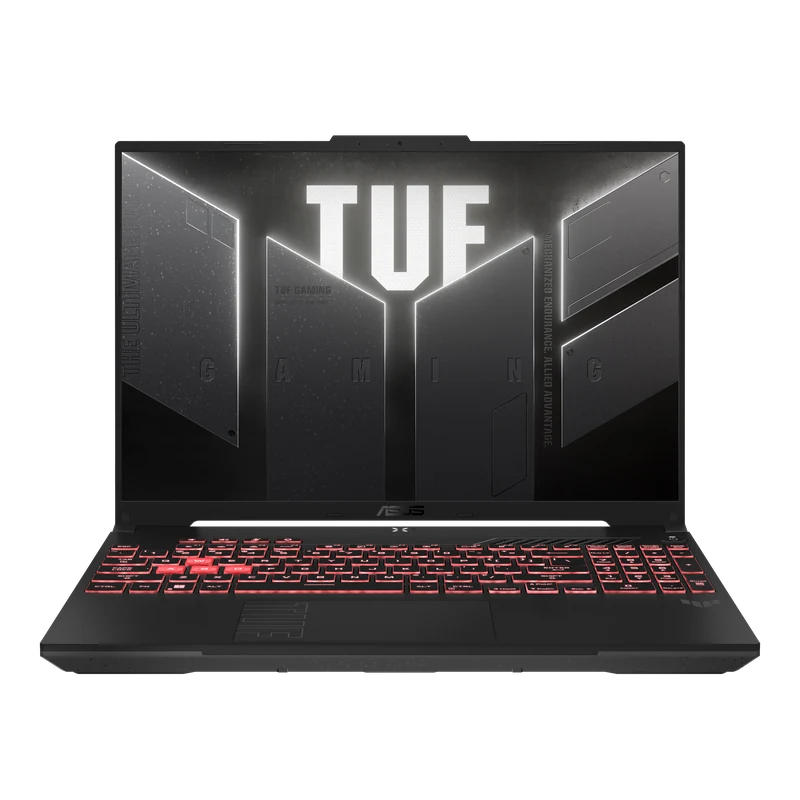
Overview and Target Buyer
ASUS's TUF Gaming line has a clear identity: MIL-SPEC durability, competitive gaming specs, and prices that undercut the ROG brand. The A16 is the 16-inch flagship of that lineup in 2026, pairing an RTX 5070 Ti with AMD's Ryzen 9 AI 9650 in a chassis that has been drop-tested, dust-tested, and temperature-cycled to military standards.
The target buyer is straightforward: someone who wants a capable gaming laptop for $1,200–1,400 that will survive being thrown in a bag, upgraded with more RAM when needed, and gamed on at 1440p without compromise. This machine serves all three priorities.
If you can stretch to ~$1,799, the Lenovo Legion 5i Gen 10 gets you an OLED panel and a slightly higher TGP. But the TUF A16 is the right call if budget is firm or durability matters most.
Full Specifications
| GPU | NVIDIA GeForce RTX 5070 Ti 12GB GDDR7 — 115W TGP |
| CPU | AMD Ryzen 9 AI 9650 (12-core, up to 5.0GHz) |
| RAM | 16GB DDR5-5600 (upgradeable to 48GB, 2 SO-DIMM slots) |
| Storage | 512GB PCIe Gen4 NVMe (second M.2 slot available) |
| Display | 16.0" FHD (1920x1080) IPS 165Hz, 300-nit, 72% NTSC |
| Battery | 90Wh (180W power adapter) |
| Weight | 2.2kg |
| Ports | USB-C (DisplayPort), USB-A x3, HDMI 2.1, 3.5mm combo |
| Connectivity | Wi-Fi 6E, Bluetooth 5.3 |
| Keyboard | 4-zone RGB, 1.7mm travel, anti-ghosting |
| Certification | MIL-STD-810H |
| OS | Windows 11 Home |
Display
The base TUF A16 ships with a 1080p 165Hz IPS panel. It is adequate but not exciting — 300-nit brightness limits outdoor use, and 72% NTSC coverage means colors look slightly washed out versus the sRGB panels in ASUS's ROG lineup.
For esports at 165Hz the panel is sharp and fast. For single-player gaming at 1080p it is fine. The honest answer is that the display is the weakest part of this machine — ASUS cut costs here to keep the GPU budget high, and that is the right trade-off for this price point. If display quality matters more than GPU performance, look at the Legion 5i Gen 10 with OLED.
Gaming Performance and Benchmarks
The RTX 5070 Ti at 115W is a genuine 1440p GPU with DLSS 4 enabled. At 1080p with the native display it is effectively never the bottleneck — the CPU and display refresh rate become the limiting factors well before the GPU is saturated.
| Game / Settings | TUF A16 (RTX 5070 Ti) | Legion 5i Gen 10 (RTX 5070) |
|---|---|---|
| Cyberpunk 2077 — 1080p High + DLSS 4 Quality | 156 fps | 138 fps |
| Black Myth: Wukong — 1080p High + DLSS 4 | 94 fps | 82 fps |
| Forza Horizon 5 — 1080p Ultra | 178 fps | 162 fps |
| CS2 — 1080p High (no upscaling) | 248 fps | 230 fps |
| Cinebench R24 Multi | 1,820 | 2,240 |
The RTX 5070 Ti edges the RTX 5070 in GPU-bound tasks by 10–15%. The CPU comparison reveals the main weakness: the Ryzen 9 AI 9650 trails the Intel Core Ultra HX in multi-threaded workloads by about 18%. For gaming this rarely matters — gaming is GPU-bound. For video editing or code compilation, consider the Intel-based competition.
Thermals and Fan Noise
The TUF A16's thermal performance is a genuine standout. GPU temperature stabilizes at 82°C under full sustained load — among the lowest we have measured for an RTX 5070 Ti machine. ASUS achieved this with a large dual-fan layout and generous heatsink contact area, trading some chassis thinness for cooling headroom.
Fan noise peaks at 44dB in Performance mode — quieter than many flagships at full load. In Balanced mode the fans are barely audible at 36dB. This is a machine you can game on without headphones and not feel assaulted by fan noise.
Battery Life
The 90Wh battery delivers approximately 6 hours of web browsing and productivity tasks with the GPU in eco mode. Gaming drops this to 2.5–3 hours. These are above-average results for a machine at this GPU tier, and the 180W adapter is compact and light enough to carry comfortably.
Build Quality and Durability
MIL-STD-810H certification means the TUF A16 has been tested against 26 specific conditions — temperature extremes, altitude, humidity, vibration, and drop resistance. In practice this translates to a lid that flexes less than most competitors, a keyboard deck that does not bend under typing pressure, and a machine that survives being bumped in a bag without visible concern.
The matte-finished aluminum lid and plastic underside are sturdy. There is some keyboard flex under firm typing pressure, but nothing alarming. Hinge quality is solid. For a student or frequent traveler, the TUF A16's durability advantage over fashion-focused competitors is real and meaningful.